
Arthritis, osteoarthritis and osteoporosis are terms that are often confused. Although all three can affect the musculoskeletal system, they are not the same condition and do not affect the body in the same way.
Arthritis is associated with inflammation of the joints; osteoarthritis involves degenerative changes affecting the joints; and osteoporosis primarily affects bone strength.
Understanding the difference between arthritis, osteoarthritis and osteoporosis is important for recognising symptoms and, above all, determining what type of assessment and treatment each patient may need.
Artritis, artrosis, osteoporosis: principales diferencias
Although these conditions may share certain risk factors and occur at the same time, each affects the musculoskeletal system differently:
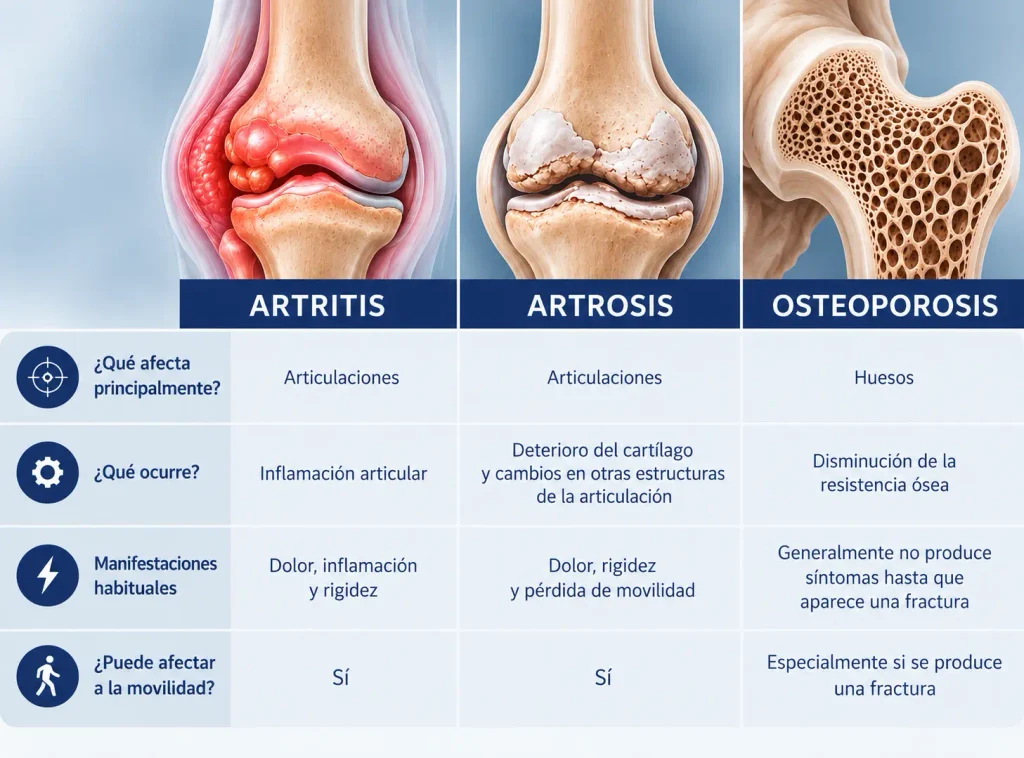
- Arthritis: Inflammation affecting one or more joints.
- Osteoarthritis: Degenerative changes affecting cartilage and other structures within a joint.
- Osteoporosis: Reduced bone strength, increasing the risk of fractures.
However, these differences require a little more explanation.
Why Are Arthritis, Osteoarthritis and Osteoporosis Often Confused?
These conditions are frequently confused because they all affect the musculoskeletal system and may become more common with age. However, their underlying causes and the structures they affect are different.
Pain can also contribute to this confusion. Someone may seek medical advice for knee, hip, back or hand pain without knowing whether it originates from a joint, a bone or another structure.
For this reason, symptoms alone are not always enough to identify the underlying problem. A clinical examination and, when necessary, imaging or other diagnostic tests can help establish the cause.
What Is Arthritis?
Arthritis refers to inflammation of one or more joints. It is not a single disease: there are several types of arthritis, and they can have different causes.
Symptoms may include pain, swelling, stiffness, warmth around the affected joint and difficulty moving it.
Some forms of arthritis are associated with autoimmune diseases, while others may have infectious or metabolic causes or be linked to other conditions.
For this reason, when a joint remains inflamed, it is important to identify the cause before deciding on treatment.
What Is Osteoarthritis?
Osteoarthritis is a joint condition characterised by degenerative changes affecting cartilage and other joint structures, as described by the Spanish Society of Rheumatology.
Cartilage allows joint surfaces to glide smoothly against each other with minimal friction. When this tissue deteriorates, changes can develop within the joint that contribute to pain, stiffness and a gradual loss of mobility.
Osteoarthritis can affect different joints, although it is particularly common in areas exposed to weight-bearing or repeated use, such as:
- Knees
- Hips
- Hands and fingers
- Spine
- Shoulders
Age is one risk factor, but it is not the only one. Previous joint injuries, certain anatomical abnormalities, excessive joint loading and some metabolic factors may also influence the development and progression of osteoarthritis.
Having osteoarthritis does not simply mean that a joint has become “worn out with age”. Every patient requires an individual assessment.
Are Arthritis and Osteoarthritis the Same Thing?
No. Although both affect the joints and can cause pain and restricted movement, arthritis and osteoarthritis are not interchangeable terms.
Arthritis is characterised by an inflammatory process within a joint and may have several different causes. Osteoarthritis, on the other hand, involves degenerative changes affecting cartilage and other joint structures.
There may also be differences in how symptoms develop, how the conditions progress and which treatments are needed.
When joint pain or swelling persists, it is therefore important to identify the underlying cause rather than assuming it is simply due to wear and tear.
What Is Osteoporosis?
Unlike arthritis and osteoarthritis, osteoporosis primarily affects the bones rather than the joints.
It is characterised by reduced bone strength, making bones more fragile and increasing the risk of fractures.
One of its most important characteristics is that it can progress for years without causing obvious symptoms. For some patients, the first sign of osteoporosis is a fracture following a fall or relatively minor injury.
Osteoporosis-related fractures are particularly common in certain areas, including the vertebrae, hip and wrist.
For this reason, assessing fracture risk and identifying osteoporosis are particularly important for people with relevant risk factors.
Does Osteoporosis Cause Pain?
One important difference between osteoporosis and other musculoskeletal conditions is that osteoporosis itself is usually symptom-free, particularly in its early stages.
Pain may develop when a fracture occurs as a result of bone fragility. Some vertebral fractures, for example, can cause back pain, changes in posture or loss of height.
Because osteoporosis can develop silently, assessing risk factors and carrying out appropriate investigations may help identify reduced bone strength before certain complications occur.
So, What Is the Difference Between Arthritis, Osteoarthritis and Osteoporosis?
An easy way to remember the difference is to consider which structure is affected and what is happening to it:
- Arthritis: Inflammation occurs in one or more joints.
- Osteoarthritis: Degenerative changes affect the joint and its various structures.
- Osteoporosis: Bone strength decreases, increasing the risk of fractures.
Although all three terms are commonly used when discussing musculoskeletal problems, they describe different processes and may require different approaches to treatment.
Can You Have Arthritis, Osteoarthritis and Osteoporosis at the Same Time?
Yes. These conditions are not mutually exclusive.
For example, someone may have knee osteoarthritis as well as osteoporosis. Similarly, some patients with inflammatory joint diseases may also experience reduced bone strength.
This is particularly important because musculoskeletal pain does not always have a single cause.
Correctly identifying which structures are affected and what is causing the symptoms allows a more appropriate treatment plan to be developed for each situation.
How Are Arthritis, Osteoarthritis and Osteoporosis Diagnosed?
Diagnosis begins with a clinical assessment. The specialist considers the patient’s symptoms, how they have developed, their medical history and the findings of a physical examination.
Depending on the individual case, additional investigations may be needed.
For joint conditions, X-rays, ultrasound scans, MRI scans or other investigations can provide information about the affected structures. Blood tests may also be necessary when certain forms of arthritis are suspected.
For osteoporosis, specific tests are available to assess bone health, such as a bone density scan (DXA scan). These may be recommended according to the patient’s age, medical history and risk factors.
Not every patient needs the same investigations. The choice depends on their symptoms and the findings of the specialist’s assessment.
Is the Treatment the Same?
No. Because arthritis, osteoarthritis and osteoporosis are different conditions, their treatments also differ.
The approach depends on the diagnosis, the affected joint or structure, the severity of symptoms, how the condition has progressed and the individual characteristics of the patient.
Depending on the case, treatment may include medication, changes to certain lifestyle habits, physiotherapy, therapeutic exercise, specific pain management treatments or procedures targeting the affected joint.
Surgery may also be considered for certain joint conditions when there is a medical indication and conservative treatment has not provided an adequate outcome.
The aim should therefore not be simply to treat the pain, but first to identify what is causing it.
Joint Treatments at TraumaCare Clinic

At TraumaCare Clinic, treatment is tailored to each patient after identifying the underlying problem and assessing the condition of the affected joint.
Depending on the diagnosis, symptoms and individual circumstances, treatment may combine medical care, physiotherapy and therapeutic exercise with other specific options.
For certain joint problems, particularly in patients with osteoarthritis and selected cases of inflammatory joint conditions, our specialists may consider injection treatments such as hyaluronic acid or platelet-rich plasma (PRP).
The suitability of these treatments depends on the individual case and the therapeutic objective. Not all patients or joint conditions require the same approach.
PRP is prepared using a sample of the patient’s own blood, which is processed to obtain a concentration of platelets before being injected into the indicated area.
Both PRP and hyaluronic acid are among the options a specialist may consider as part of a personalised treatment strategy.
Where appropriate, this approach can be combined with physiotherapy and therapeutic exercise at TraumaCare Physio, with the aim of improving mobility, restoring function and supporting recovery.
When Should You See a Specialist?
Not all joint pain requires the same type of assessment. It is advisable to seek medical advice if you experience symptoms such as:
- Persistent or recurring joint pain
- Swelling in a joint
- Stiffness that makes everyday activities difficult
- A gradual loss of mobility
- Pain that limits sports or normal physical activity
- Pain following an injury that does not improve over time
- Fractures resulting from relatively minor injuries
- New-onset back pain, particularly if you have risk factors for osteoporosis
A clinical examination and, when indicated, diagnostic investigations can help identify the cause and determine the available treatment options.
The Same Symptom Can Have Different Causes
Pain in the knee, hand, hip or spine does not, on its own, reveal what is happening.
The same symptom may be caused by problems involving the joints, bones, muscles, tendons or even the nervous system.
Correctly identifying the source of pain is therefore essential to determining the most appropriate treatment.
At TraumaCare Clinic, we have specialist units covering different areas of orthopaedic surgery and traumatology, including the knee, shoulder and elbow, hand and wrist, spine and pain management.
This approach allows each patient to be directed towards the appropriate specialist based on the affected area and their diagnosis.
Where indicated, treatment can also be coordinated with TraumaCare Physio, incorporating physiotherapy, therapeutic exercise and functional rehabilitation into the recovery process.
If you experience persistent pain, swelling, loss of mobility or symptoms that do not improve over time, you can arrange a specialist assessment to investigate the cause and discuss the most suitable treatment options for your individual circumstances.